
Human demonstration
Any recording that provides hand pose and contact can be used.
 CARD:Contact-Anchored Retargeting
CARD extracts, preserves, and tracks contact force targets from human demonstrations.
Humans are dexterous, but traditional data collection paradigms such as teleoperation, kinesthetic teaching, and wearable exoskeletons force humans to act through the robot embodiment, bottlenecking their dexterity. Retargeting can avoid this. However, existing methods purely translate kinematics and ignore the real-world contact dynamics essential for task success. We present CARD: Contact-Anchored Retargeting for Dexterous Manipulation, a simulator and object-free framework that retargets human demonstrations to robot actions by explicitly preserving contact force targets. CARD unifies human data sources including video, motion capture, and tactile gloves via a shared hand–contact representation and generates explicit contact force targets in addition to kinematics. To maintain these contact targets during hardware open-loop replay, CARD also introduces a tactile tracking controller. For video which does not contain an explicit tactile source, we present Vid-HACO, our video-to-contact model that sets a new state of the art. Across our video, glove, motion-capture data and the GRAB dataset, CARD maintains contact on 43–78% of contact frames, while kinematic and object-aware retargeting methods maintain contact on <10% and 22.5% of the frames respectively. Further, integrating our formulation into physics-based retargeting improves strict task success from 12% to 32% on GRAB dataset. Finally, we show that our tactile tracker is critical to reproduce demonstrated forces during hardware replay. These results establish that contact preservation via CARD is a scalable interface for transferring human dexterity to robots.
Kinematic retargeting maps fingertip positions or joint angles from the human hand to the robot hand. CARD instead preserves each contact’s location, push direction and force, and places the corresponding robot link on it.
Any recording that provides hand pose and contact can be used.
Each source becomes a MANO hand sequence with at most one contact force anchor C_f=(c_f,\hat d_f,F_f) per hand region and frame, attached to the hand rather than the object.
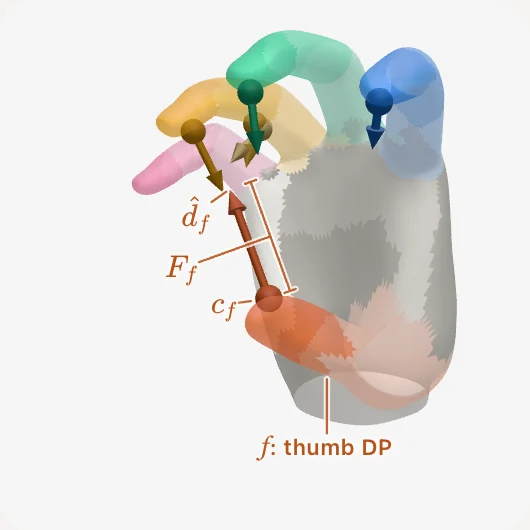 regions and anchors
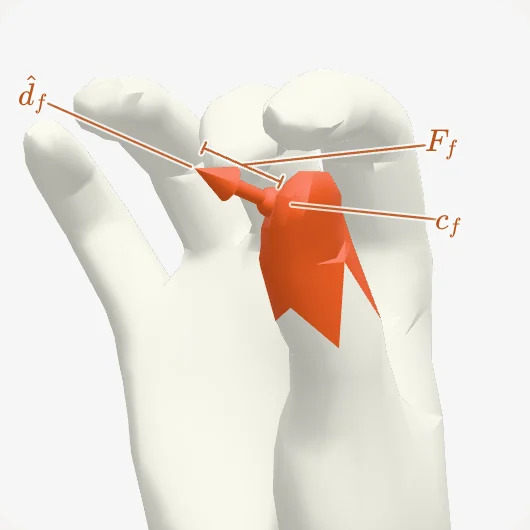 thumb-tip anchor

Finger flexion and abduction are transferred from the human skeleton in closed form, the thumb through a fixed affine map of its bone directions and pad normal, and the wrist pose is set so the robot fingertips align with the human’s. No optimization is involved.
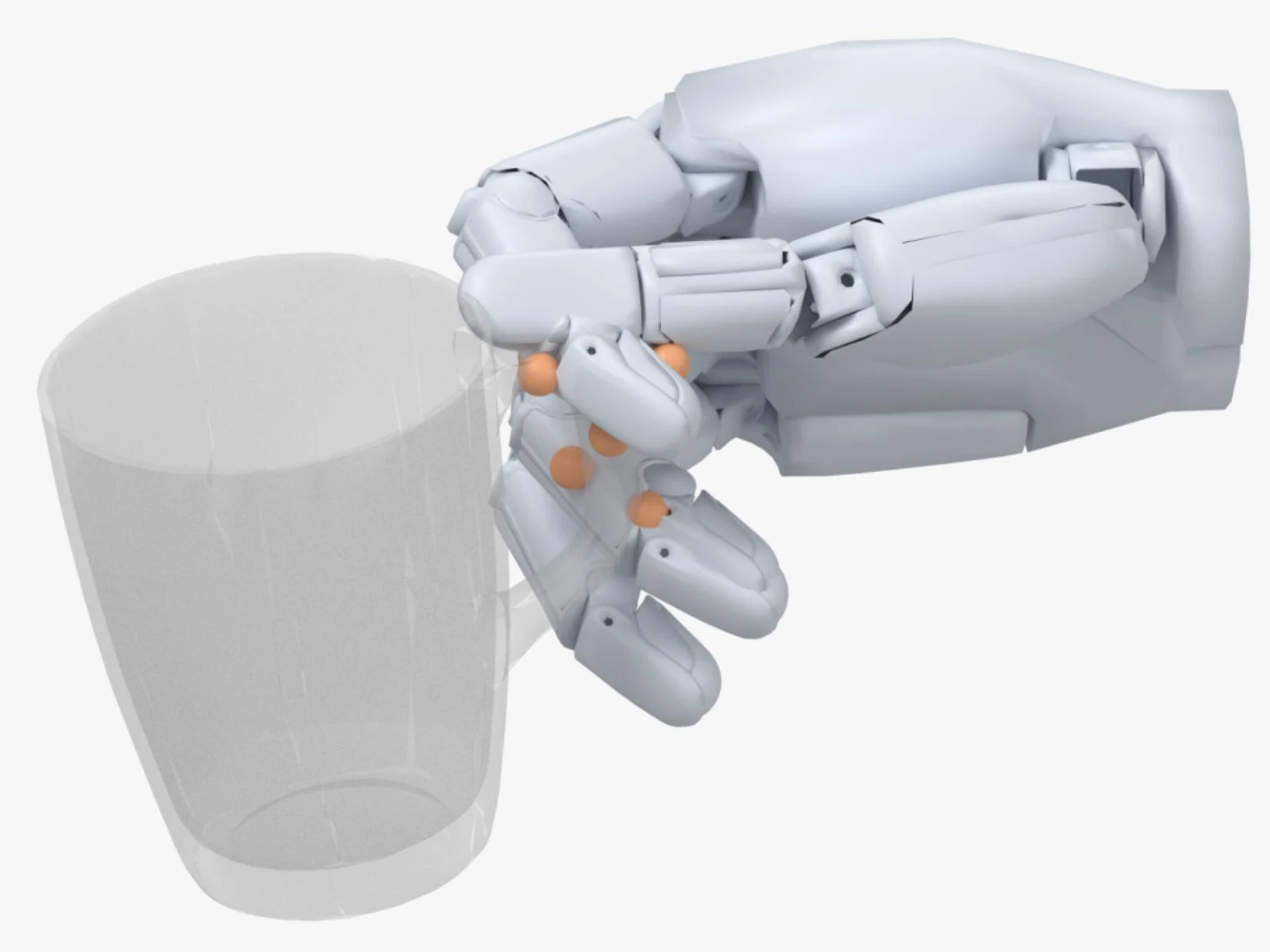
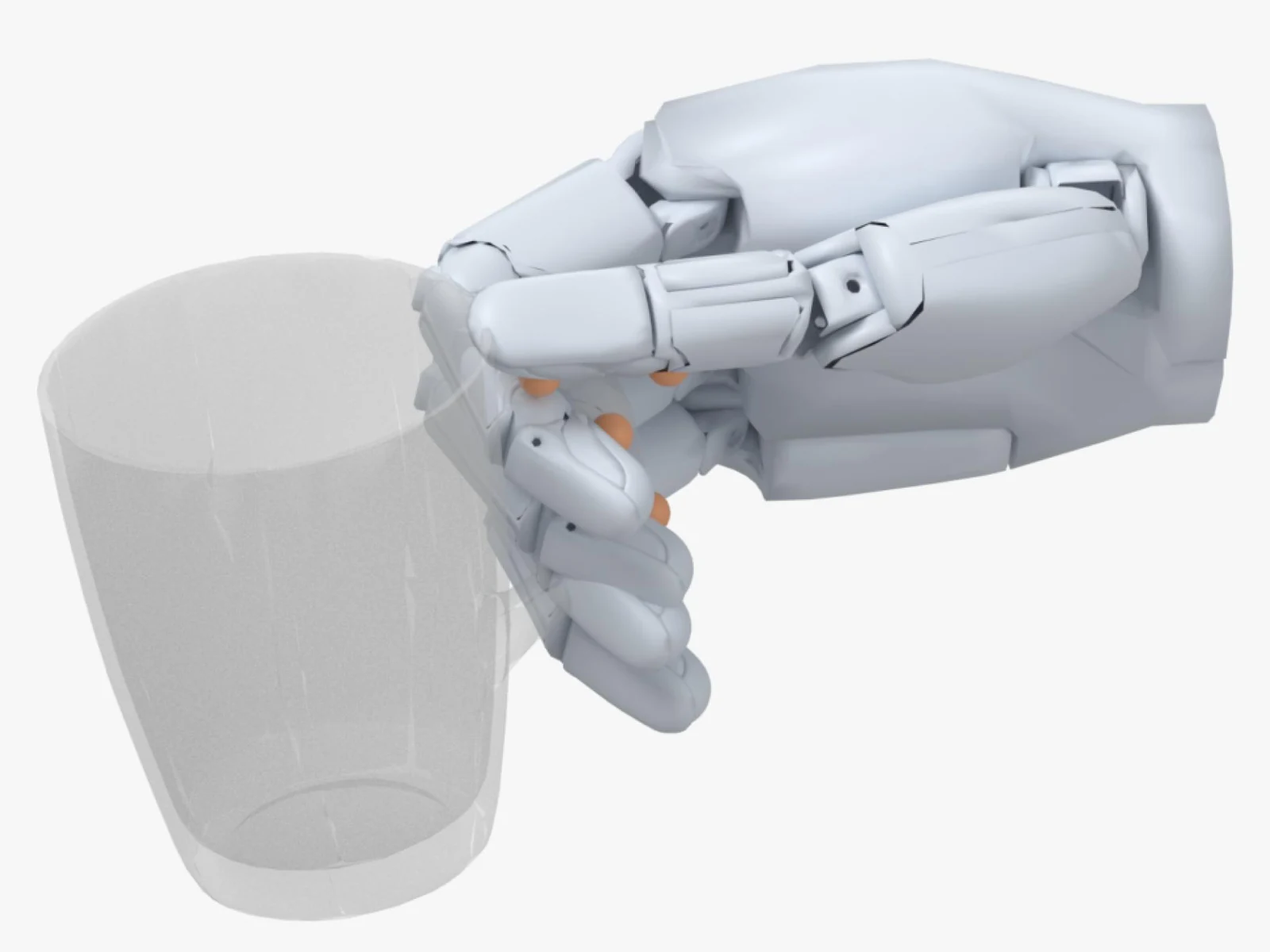
For every frame, CARD solves for the wrist pose and joint angles q:
E_{\mathrm{contact}} puts each anchored robot pad on its contact force target, facing the push; the other terms handle free fingers, smoothness and collisions. CARD minimizes it with an annealed CEM sampler on the GPU.
Replay follows the retargeted joint targets, while each finger in contact closes a little further until its fingertip sensor reads the desired force; a feedforward torque adds that force directly.
Each source outputs the same anchored MANO sequence, so one solver serves all three.
HaWoR hand pose, Vid-HACO contact
744-taxel pressure, wrist tracker
OptiTrack markers over the tactile glove
Vid-HACO predicts per-vertex hand contact from 8-frame video clips with a V-JEPA 2.1 encoder, trained on 1.55M frames from 12 datasets.
186 demonstrations retargeted to the SHARPA Wave: our 86 clips (20 phone videos, 18 tactile-glove clips, 48 motion-capture-with-glove clips) and 100 GRAB clips. A contact is established when the anchor lies within 2 mm of the assigned link and is reached with its palmar face.
Penetration is scored only on GRAB, against its ground-truth object meshes.
| CARD | DexPilot | AnyTeleop-K | AnyTeleop-P | ReGrind (w/ object) | CARD (init only) | |
|---|---|---|---|---|---|---|
| Our data: monocular video (20 clips) | ||||||
| Contact rate (%) | 61.4 | 9.7 | 8.3 | 7.6 | – | 20.5 |
| Correct finger (%) | 60.1 | 9.5 | 8.0 | 7.5 | – | 19.2 |
| In cone (%) | 35.2 | 4.2 | 4.7 | 5.0 | – | – |
| Gap, median (mm) | 2.40 | 9.99 | 10.80 | 13.19 | – | 5.76 |
| Our data: tactile glove + motion capture (66 clips) | ||||||
| Contact rate (%) | 77.7 | 3.8 | 3.4 | 3.5 | – | 15.9 |
| Correct finger (%) | 76.9 | 3.7 | 3.3 | 3.2 | – | 15.8 |
| In cone (%) | 46.0 | 1.1 | 1.0 | 2.3 | – | – |
| Gap, median (mm) | 1.38 | 17.17 | 16.67 | 23.22 | – | 9.32 |
| GRAB (100 clips) | ||||||
| Contact rate (%) | 43.1 | 4.9 | 4.9 | 4.6 | 22.5 | 19.6 |
| Correct finger (%) | 40.6 | 4.8 | 4.9 | 4.5 | 20.7 | 17.8 |
| In cone (%) | 16.2 | 1.7 | 1.7 | 1.7 | 5.2 | 3.8 |
| Gap, median (mm) | 3.56 | 20.90 | 20.45 | 20.66 | 7.86 | 13.78 |
| Penetration, median (mm) | 7.96 | 12.71 | 12.79 | 13.02 | 9.80 | 11.15 |
ReGrind takes the object mesh as input, so it runs on GRAB only. CARD uses a contact hull as the collision object there, and the GRAB mesh only to score penetration.
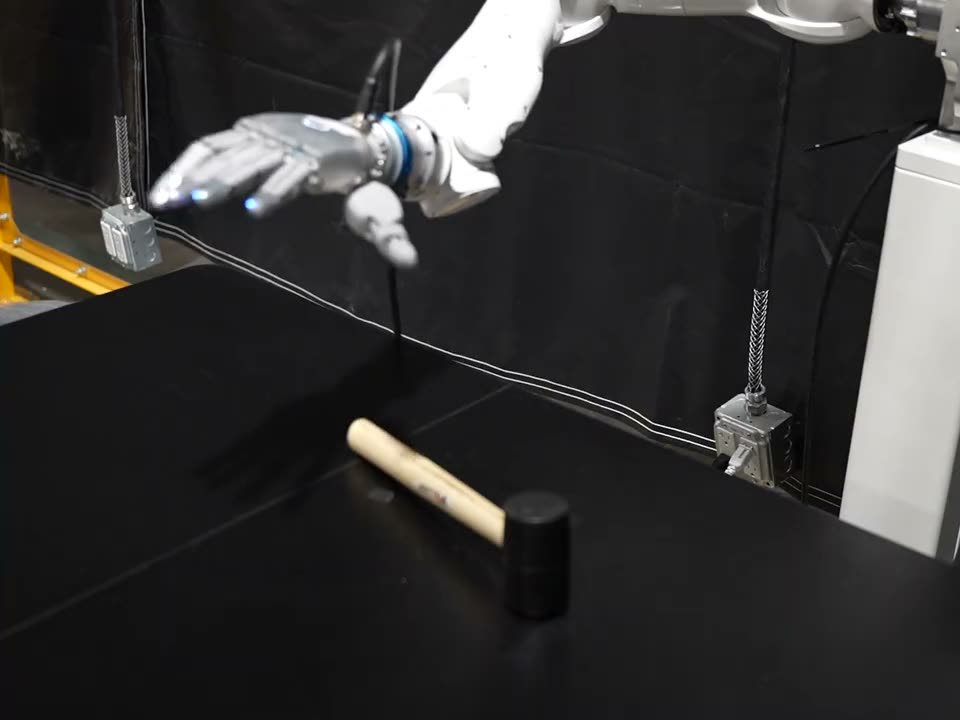
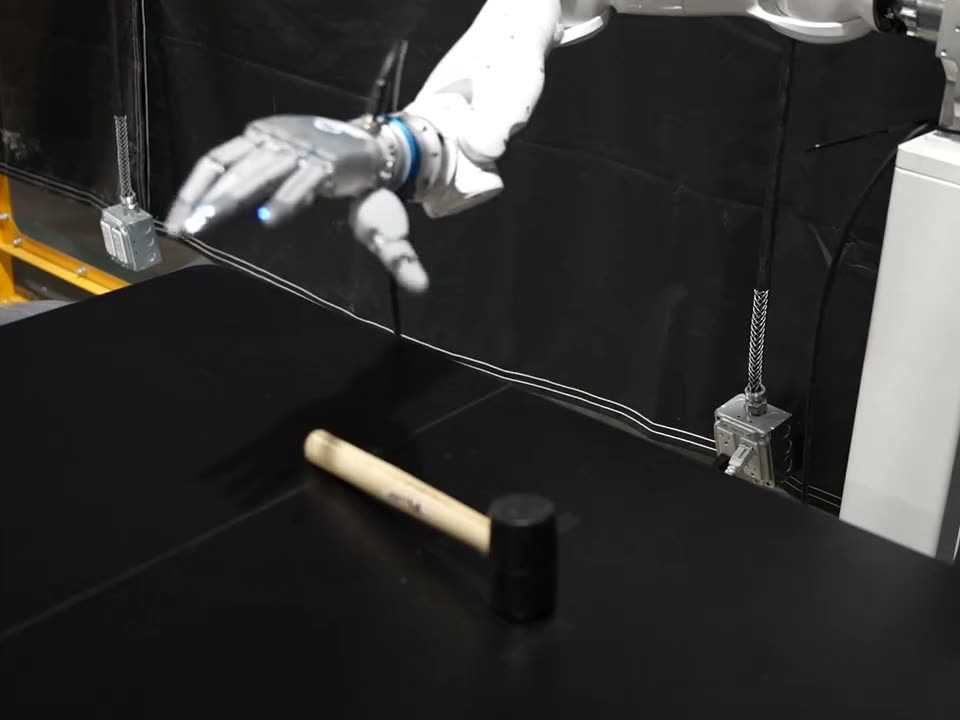
Each human hand region maps to a robot link and its grasping face; the anchors, costs and weights stay the same.
@misc{dai2026card,
  title         = {{CARD}: Contact-Anchored Retargeting for Dexterous Manipulation},
  author        = {Cunxi Dai and Botao He and Francois R. Hogan and Wei Pan and Rao Fu and Wen-Han Hsieh and Ruoshi Liu and Jitendra Malik and Guanya Shi and Akash Sharma},
  year          = {2026},
  eprint        = {2610.36539},
  archivePrefix = {arXiv},
  primaryClass  = {cs.RO},
  url           = {https://arxiv.org/abs/2610.36539}
}